Collaboration projects with Republic of
Moldova – 2023 Call
Project code: PN-IV-P8-8.3-ROMD-2023-0027
Project title: “3D Aeromaterials integrated in sensitive
modules for sensor applications”
Project Acronym:
AeroSENS
Total Funding: 477.500,00 lei
Project
time: 24 months
Project
Leader: CS II Dr.ing. Cornelia BANDAS
https://www.brainmap.ro/cornelia-elena-bandas-ratiu
Contact:
Tel:
+40 256222119
Fax:
+40 256201382
e-mail:
cornelia.bandas@gmail.com
Financing Authority: Ministry
of Research, Innovation and Digitization, CNCS - UEFISCDI
Coordinator: National
Institute for Research and Development in Electrochemistry and Condensed Matter
Timisoara -INCEMC, Romania
Partner: Technical
University of Moldova (TUM), National Center for Material Study and Testing,
Chisinau
Project
Abstract
The demand for innovative materials
encourages researchers to developed a new type of sensors based on
aero-materials for gas detection. Therefore, the aim of the AeroSENS
project consists in obtaining of sensitive modules based on 3D-aeromaterials
using a sacrificial ZnO template by
microwave-assisted hydrothermal (MWH) method. Therefore, as part of the joint
research-development collaboration, will be organized knowledge exchange
seminars between the two teams regarding the alternative methods of obtaining
and characterizing aero-materials and dissemination of the project results. The
novelty of bilateral cooperation project consists in obtaining by the
microwave-assisted hydrothermal method of the sensitive modules based on 3D
aero-TiO2/aero-β-Ga2O3 heterostructures
made from aero-TiO2 (n-type) coupled with aero-β-Ga2O3 (n -
type) forming an n-n heterojunction, with application in COx
gas detection.
The project will be realized using the
multidisciplinary and interdisciplinary expertise of the research groups from
National Institute for Research and Development in Electrochemistry and
Condensed Matter Timisoara (INCEMC) - Project coordinator and Technical University of Moldova
(TUM), National Center for Material Study and Testing (NCMST), Chisinau -
Partner.
Project objectives
O1. ACHIEVEMENT
OF JOINT RESEARCH-DEVELOPMENT COLLABORATION AND DISSEMINATION
OF THE PROJECT RESULTS
O2. DEVELOPMENT AND CHARACTERIZATION OF POWDERS (PW-TiO2 AND PW-β-Ga2O3)
AND 3D-AEROMATERIALS (AERO-TiO2 AND AERO-β-Ga2O3)
BY MICROWAVE-ASSISTED HYDROTHERMAL METHOD
O3. DESIGN, ACHIEVING
AND TESTING THE FUNCTIONALITY OF SENSITIVE MODULES
BASED ON PW-TiO2 / PW-β-Ga2O3 (TYPE I) AND 3D AERO-TiO2/AERO-β-Ga2O3 HETEROSTRUCTURES (TYPE II) FOR COX GASES DETECTION
O4.
DISSEMINATION
AND COMMUNICATION OF THE VALUABLE RESULTS
Project Team
COORDINATOR – INCEMC TIMISOARA, ROMANIA
Dr. eng. Cornelia BANDAS –
scientific reasearcher II, project leader - has research expertise in the nanostructured
materials synthesis based on oxides materials; heterostructures based on TiO2,
ZnO and CuMnO2; development of hydrothermal methods; development of
synthesis installations for obtaining new materials with multiple applications.
Will coordinate research activities according to the established work plan,
ensuring the proper management of funds, organization of the working visits and
project initiation workshop; transfer of knowledge.
Dr. Carmen LAZAU - scientific
reasearcher I, key person - has
a high expertise in hybrid structures based on TiO2-polymers used as
sensors for detection of explosive materials (TNT); sensors based on
heterostructures TiO2/CuMnO2 and ZnO/CuMnO2 for
gases detection; development of hydrothermal synthesis methods; synthesis of
micro-nanostructured materials based on TiO2, mesoporous TiO2
integrated in polymers for biomedical applications and self-cleaning TiO2.
Dr. eng.
Corina ORHA– scientific researcher III, key person - has a good experience in
obtaining of porous DSA materials; development
electrode-based carbon structures, applied in photocatalysis and
photoelectrochemical processes for pollutants removal; morpho-structural
characterization of composite materials, specialist in morphological microscopy
(SEM/EDX); nanomaterials synthesis by conventional (sol-gel, hydrothermal) and
non-conventional (microwave and fast hydrothermal) methods; synthesis of micro
- and nano-materials based on zeolite, activated carbon and TiO2
Dr. phys. Cristian CASUT,
postdoctoral scientific researcher – his research expertise is
related to synthesis of semiconductor materials; development of solar cell;
hydrothermal synthesis; structural characterization by XRD and UV-VIS methods
PhD student, Eng. Mina-Ionela MORARIU
(POPESCU) – has research expertise in synthesis and
characterization of micro and nanostructured materials; synthesis of
heterostructures; deposition techniques (Dr. Blade, spin-coating, dip-coating);
electrochemical measurements of sensors; supercapacitors and heterojunction; inorganic chemistry synthesis.
Dr.eng. Mircea
NICOLAESCU – postdoctoral
scientific researcher - research expertise is related to the
development of sensors based on thin oxide films for UV and gas detection; the
synthesis of one and two-dimensional oxide layers using various synthesis
processes, and their application in sensor technologies; installation
development; electrical and electrochemical measurements
Partner
- TECHNICAL UNIVERSITY OF MOLDOVA (TUM), NCMST CHISINAU
Dr.
Victor ZALAMAI – senior researcher, partner leader - will
coordinate research activities of the NCMST, TUM team, particularly will
formulate the work schedule of PhD students for research tasks at the TUM and
during their visits at the INCEMC Timisoara; optical and photoluminescence
characterization of aero-semiconductor developed at the INCEMC by means of
hydrothermal method; research expertise in the micro- and
nano-structuring of ZnO, GaN,
TiO2 semiconductors and their optical characterization by means of
continuum wave and time resolved photoluminescence spectroscopy, Raman
scattering, reflectance and transmission spectroscopy, in development and
characterization of aero-semiconductor materials.
Dr.
Tudor BRANIȘTE – postdoctoral scientific researcher - has
research expertise in 2D and 3D nanoarchitectures based on GaN
for engineering applications; development of aero-GaN,
aero-Ga2O3, aero-ZnS and aero-ZnGa2S4
materials by means of HVPE technology and aero-TiO2 by means of ALD
technology; electrochemical and photoelectrochemical etching; scanning electron
microscopy; atomic force microscopy; plasma proceeding, electrical and optical
characterization of nano-sensors, nanobiotechnology.
PhD
student Tatiana GALATONOVA - scientific researcher – expertise
in materials synthesis, designing and coordinating experiments in the field of
bio-engineering; the use of the theoretical foundations of engineering sciences
and medicine on the operation principles of medical devices for the
organization and execution of diagnostic researchers, treatment procedure.
PhD
student Simon BUSUIOC – scientific researcher – expertise
in materials science, specializing in semiconductor applications and studies
about luminescence of semiconductor aero-materials based on TiO2 and Zn2TiO4;
specialist in experimental design; material synthesis; characterization; data
collection and analysis.
Phase
1 / 2024
In the initial phase, „Synthesis
and characterization of the powder materials and 3D-aeromaterials through
microwave hydrothermal methods ” scientific activities was focused on obtaining and morfological, structural and optical characterization of 3D
aero-materials based on TiO2 and β-Ga2O3,
referred to as 3D-aero TiO2 and 3D-aero β-Ga2O3
Ø Synthesis of 3D-aeromaterials based on TiO2 was achieved through microwave hydrotermal method using a temperature range of 150°C, 180°C and 200°C for 1 hour. TiO2 powder materials were initially synthesized using a clasical hydrotermal method using titanium tetrachloride as a precursor for Ti. The structural characterization results indicated that the anatase crystalline phase was achieved at 150 0C, while increasing the temperature to 200 0C leads to the rutile crystalline phase appearance. Surface morphology revealed the dimensions and spherical shape of the titanium dioxide particles while elemental analysis confirmed the material’s purity. Obtaining 3D-aero TiO2 though microwave hydrotermal conditions involves the using of pre-synthesized TiO2 powder, which was combined with ZnO micro-tetrapods and placed into quartz autoclave at temperature of 200°C, 180°C and 150°C for 1 hour. After washing and drying, the materials were heat treated in a H2 controlled atmosphere oven at 800°C for 2 hours. The results of the structural and morphological characterization indicated that ZnO was coated with TiO2, thereby conforming the effictiveness of hydrothermal process in producting TiO2-based aeromaterials.
Ø The 3D-aeromaterials based on β-Ga2O3 were synthesized through the microwave hydrothermal method using temperatures range of 150°C, 180°C and 200°C for 1 hour, using a stock solution of Ga(NO₃)₃ at pH5 together with ZnO microtetrapods to obtain 3D-aero β-Ga2O3. After the microwave treatment, the materials were subjected to heat treatment in a hydrogen (H2) atmosphere at 800°C for 2 hours to ensure the complete removal of ZnO tetrapods. The results of the structural and morphological characterization indicated the presence of a ZnO structure covered with β-Ga2O3 particles, thereby confirming the effictiveness of the hydrothermal process in the synthesis of β-Ga2O3-based aeromaterials.
To assessment
of the morpho-structural and optical characteristics of 3D aeromaterials
based on TiO2 and β-Ga2O3
were used analysis techniques including XRD, SEM/EDX, UV-Vis si
FT-IR. The structural characterisation results
through X ray diffraction revealed the crystalline phases of the materials and
facilitated the identification of specific compound peacks.
Using SEM analysis the surface morphology confirmed
the deposition of titanium dioxide and Ga2O3 on the surface
of ZnO micro-tetrapods,
while EDX analysis facilitated elemental identification and confirming the materials’purity.
During the
initial phase / 2024 a research internship was realised
by the senior researcher and PhD students from Technical University of the
Republic of Moldova at INCEMC Timisoara, where the objectives proposed in the implementation
plan were successfully achieved.
Results Dissemination 2024
ISI papers:
1.
Cornelia Bandas, Corina Orha,
Mircea Nicolaescu, Mina‐Ionela
Morariu (Popescu) and Carmen Lăzău, “Review-2D
and 3D Nanostructured Metal Oxide Composites as Promising Materials for
Electrochemical Energy Storage Techniques: Synthesis Methods and Properties”,
Int. J. Mol. Sci. 2024, 25, 12521. https://doi.org/10.3390/ijms252312521;
2.
Mircea Nicolaescu, Sebastian Ambrus, Petru Hididis, Mina Morariu
(Popescu), Iosif Hulka,
Corina Orha, Carmen Lazau,
Cosmin Codrean and Cornelia Bandas*,
“In Situ Synthesis of NPC-Cu2O/CuO/rGO Composite via Dealloying and Microwave-Assisted
Hydrothermal Technique”, Crystals 2024, 14, 968. https://doi.org/10.3390/cryst14110968
3.
Mina-Ionela Morariu (Popescu), Mircea Nicolaescu, Corina Orha,
Carmen Lazau, Cornelia Bandas*,
“Comparative Morpho-Structural and Electrochemical Characterization of
FTO-Based Oxide Films Correlated with Synthesis Method”, Proceedings of the
30th International Symposium on Analytical and Environmental
Problems, ISBN 978-963-688-009-5, pages 133-137, Szeged 2024,
Hungary.
Scientific
communications:
1.
Cornelia
Bandas, Mina-Ionela Morariu,
Mircea Nicolaescu, Tudor Braniste, Corina Orha, Carmen Lazau, „Comparative
Morpho-Structural Characterization of Titanium Dioxide Materials Correlated
with the Hydrothermal Synthesis Method”, International Conference of
Materials Science & Engineering Materials 2024, 22-23 August 2024, Lisabon, Portugal, virtual conference- invited talk.
2. Cornelia Bandas,
Mina-Ionela Morariu, Mircea Nicolaescu, Corina Orha,
Carmen Lazau, „One-Step Microwave-Assisted
Hydrothermal Synthesis of Doped TiO2 Nanoparticles”,11th International Conference On Structural Analysis Of Advanced Materials, 6-10
October 2024, Protaras, Cipru
- poster;
3. Mina-Ionela Morariu (Popescu), Mircea
Nicolaescu, Carmen Lazau, Corina Orha,
Cornelia Bandas, “Effect of PH on the
Microstructure of β-Ga2o3 Synthesized by
Microwave-Assisted Hydrothermal Method” 7th International
Conference on Emerging Technologies in Materials Engineering – EmergeMAT, 30-31
October 2024 – Bucharest, Romania – poster;
4. Mina-Ionela
Morariu (Popescu), Mircea
Nicolaescu, Corina Orha, Carmen Lazau,
Cornelia Bandas, “Comparative morpho-structural
and electrochemical characterization of FTO-based oxide films correlated with
synthesis method”, 30th International
Symposium on Analytical and Environmental Problems, 7-8 October 2024,
Szeged, Hungary – poster;
5. Mircea
Nicolaescu, Mina-Ionela Morariu (Popescu), Narcis
Duţeanu, Iosif Hulka, Corina Orha, Carmen Lăzău, Cornelia Bandas,
„Cu2O/CuO(NW) flexibile supercapacitor
electrode fabricated on copper mash” 7-8 October 2024, Szeged, Hungary – poster.
Phase
2 / 2025 (January
- December 2025)
In the phase 2, “Designing and implementation of the
functionality of sensitive modules for detection of the CO2 gases” scientific activities were
focused on design and fabrication of sensitive modules based on PW-TiO2
/ PW-β-Ga2O3 heterostructures (type I) and
heterostructures 3D Aero-TiO2 / Aero-β-Ga2O3
(type II), correlated with morpho-structural, electrochemical and electrical
characterization of type I and II sensitive modules.
Ø Achievement of sensitive modules based on PW-TiO2 /
PW-β-Ga2O3 heterostructures (type I) was
achieved in two stages: A) synthesis of composite materials based on PW-TiO2
/ PW-β-Ga2O3 by microwave-assisted hydrothermal
condition; B) fabrication of sensitive modules based on composite materials by
spin-coating deposition at 1500 rotations / minutes, for 10 seconds.
The advantages of the microwave-assisted hydrothermal
condition are related to: a simple way of working in which the reaction time is
much shorter than in the case of other methods (for example the classic
hydrothermal method), implicitly the energy efficiency is higher; the deposition
method of the sensor based on composite materials is simple and fast, with low
reagent costs, environmentally friendly; increasing of the UV illumination
current, keeping the DARK current low at different supply voltage.
Ø Achievement of sensitive modules based on 3D Aero-TiO2
/ Aero-β-Ga2O3 (type II) heterostructures (type II)
was achieved by spin-coating deposition of aero-TiO2 and aero-β-Ga2O3
on the ceramic interdigital electrodes (figure 1).
|
|
|
|
|
|
|
Figure 1.
Sensitive modules of the 3D Aero-TiO2 (a) and Aero-β-Ga2O3 (b).
Schematic process for fabrication of sensitive modules (c) |
|


 ©
©During the phase 2 / 2025 a research internship
were realized by the senior researcher and PhD students from
Technical University of the Republic of Moldova at INCEMC Timisoara, where the
objectives proposed in the implementation plan were successfully achieved.
Results Dissemination 2025
ISI
papers:
1. M.-I. Morariu (Popescu), M. Nicolaescu,
C. Orha, C. Lăzău, N. Duteanu, C. Bandas, ‘Heterostructure Based
of Ti-TiO2(NW)/rGO Hybrid Materials for Electrochemical
Applications’, Inorganics 2025, 13(2), 31; https://doi.org/10.3390/inorganics13020031
2. C. Orha, M.-I. Morariu (Popescu), M. Nicolaescu, C.
Bandas, C. Lazau, ‘Synthesis
and Investigation of Na-Zeolite-Decorated
Black TiO2 Hybrid Material with Enhanced Properties’,
Crystals 2025, 15(4), 319;
https://doi.org/10.3390/cryst15040319.
3. C. Orha, M. Nicolaescu, M.-I. Morariu (Popescu), T. Galatonova, S. Busuioc, C. Lazau, C. Bandas, ‘A Comprehensive
Review on Aero-Materials: Present and Future Perspectives’, Coatings
2025, 15(7), 754; https://doi.org/10.3390/coatings15070754
4. M. Nicolaescu, M.-I. Popescu(Morariu), C. Codrean, I. Hulka, C.Orha, Cl Lazau, C. Bandas, N. Duteanu,’’Fabrication and performance evaluation of the NPC/amorphous-Sn2P2O7 by dealloying of CuNiSnP alloy for supercapacitor application’’, Sustainable Energy Technologies and Assessments, 80, 2025, 104383;
5. S. Căprărescu, G. T. Tihan, R.
G. Zgârian, A. M. Grumezescu, C. Lazau, C. Bandas, L. I. Atanase and C.-A.
Nicolae ‘Synthesis and Characterization of Cellulose Acetate/Polyethylene
Glycol/Poly(Styrene)-b-Poly(4-Vinylpyridine)membrane
Embedded with Hydrotermaly Activated TiO2 Nanoparticles for
Waste-Waters Treatment by Membrane Processes’, Polymers 2025, 17,
446. https://doi.org/10.3390/polym17040446
6. M. Nicolaescu,
T. Braniste, C. Orha, M.-I. Morariu, S. Lehman, K. Nielsch, I. M. Tiginyanu, R.
Faur, V. Zalamai, C. Lazau, C. Bandas “Room Temperature UV Photodetector
Based on Aero-Titania” Int. J. Mol. Sci. 2025, 26, 11035.https://doi.org/10.3390/ijms262211035
Scientific
communications:
1. C. Bandas,
M. Nicolaescu, T. Braniste, I.M. Tighineanu, M.-I. Morariu, C. Orha, C. Lazau, “TiO2-based Heterostructures for
Sensing Applications“, EmergeMAT 8th
International Conference on Emerging Technologies in Materials
Engineering, 06-07 Octombrie 2025, Bucuresti, Romania; Conferinta
Online – oral presentation
2. C. Bandas, M.
Nicolaescu, T.Braniste, I.M.
Tighineanu, M.-I. Morariu, C. Orha,
C. Lazau, “Ultraviolet Photodetectors based on TiO2-Composite
Materials” ISAEP 31st
International Symposium on Analytical and Environmental Problems 13-14 Octombrie 2025, Szeged, Ungaria –
oral presentation
3. M. Nicolaescu, T. Braniste, C. Orha, M.-I. Morariu,
S. Lehmann, K. Nielsch, I. M. Tiginyanu,
V. Zalamai, C. Lazau, C. Bandas, „Integration of Aerotitania
Microtubes in UV Photodetectors”, ISAEP 31st International
Symposium on Analytical and Environmental Problems 13-14 Octombrie
2025, Szeged, Ungaria –poster;
4. C. Bandas, M. Nicolaescu, C. Orha,
M.-I. Morariu, T. Galatonova, S. Busuioc,
T. Braniste, C. Lazau, „Aero-TiO2 Materials for Evaluation of
Near-Ultraviolet Photodetector”, ICCT 2025 27th International Conference on Chemical
Thermodynamics 20-24 iulie 2025, Porto, Portugalia – prezentare poster;
5. M.-I. Morariu, B. Tăranu, M. Nicolaescu, C. Orha, C. Lazau, C. Bandas, M. Gherban, „Anticorrosive Nanomaterials of the type Zn3Nb2O8
undoped and doped with Trivalent Er3+ Ions in Saline Environment”, ISAEP
31st International Symposium on Analytical and Environmental
Problems 13-14 Octombrie 2025, Szeged, Ungaria –poster;
6. T.
Galatonova, V. Ciobanu, T. Braniste,
P. Urbanek, S. Lehmann, B. Hanulikova,
K. Nielsch, M. Masar, P. Suly, V. Ursaki, T. Sopkin, C. Bandas, I. Kuritka, V. Sedlarik, I. Tiginyanu, „Photocatalytic degradation of
tetracycline using aero-nanomaterials”, Nanomed
Europe 2025, 27-30 Mai, Barcelona, Spania - poster;
7. M.
Gherban, B. Taranu, C. Orha, C. Lazau, M. Nicolaescu, C.
Bandas, M. Morariu, „Corrosion
test in 0.1 M HCl of the pseudo-binary oxides undoped and doped with Er3+ ions”, 31st
International Symposium on Analytical and Environmental Problems, 13-14 Octombrie 2025, Szeged, Ungaria –poster;
8.
T. Braniste, M. Nicolaescu, T. Galatonova,
M.-I. Morariu, C. Lazau, C. Orha,
E.-L. Urs, F. Doroftei, D. Botstig, A. Rotaru, V. Zalamai, I.M. Tighineanu, C. Bandas, „Enhancement of the TiO2-AuQDs Sensor
for UV Detection” EmergeMAT 8th International Conference on Emerging
Technologies in Materials Engineering, 06-07 Octoombrie
2025, Bucuresti, Romania; Conferinta
Online –poster;
9. M.-I. Morariu (Popescu), M. Nicolaescu, C.
Orha, C. Lazau, C.Bandas, "Development
of an UV Photo-Detector Based on Nanocrystalline TiO2 Powder", Symposiom of Stability and
reactivity in coordination chemistry - in memoriam Mihail
Bîrzescu (SRCC), Timișoara,
România, 2025 - poster.
Book
chapter:
1. M. Nicolaescu, C. Orha, M.-I. Morariu (Popescu), V.
Şerban, S. Căprărescu, C. Lazau, C. Bandas ‘Achievement of a
UV Photodetector Based on TiO2/CuMnO2 Heterostructures: A
New Strategy’’Chemical and Materials Sciences: Developments and Innovations
Vol. 10, Chapter 8, Print ISBN: 978-93-49473-90-4, eBook ISBN: 978-93-49473-30-0.
https://doi.org/10.9734/bpi/cmsdi/v10/4345
Requested
patent applications:
1. Bandas C., Lazau C., Orha C., M. Nicolaescu, M.-I. Morariu, T. Braniste, V. Zalamai „Procedeu de Obtinere a Aeromaterialelor de tipul ZnO(Tetrapode)@TiO2 in Conditii Hidrotermale in Camp de
Microunde”, cerere
de brevet inventie depusa
la OSIM A/00255 din 19.05.2025.
2. Bandas C., F. Braniste, Nicolaescu M.,
T. Galatonova, Lazau C., Orha C., M.-I. Morariu, Rotaru
A., Ursu E.-L., Tiginyanu
I. “Senzor pe baza
de material compozit TiO2-AuQDs pentru
detectia radiatiilor ultraviolete" - cerere
de brevet inregistrata la OSIM A/00369 din
26.08. 2025
MAIN RESULTS ACHIEVED
(2024-2025)
Within phase 1 (2024) and
phase 2 (2025) of the project, were obtained main results as:
A) 3D-aeromaterials
based on TiO2 synthesized by
microwave-assisted hydrothermal method temperature range 150-200°C for 1 hour;
B) 3D-aeromaterials
based on β-Ga2O3 synthesized by
microwave-assisted hydrothermal method temperature range 150-200°C for 1 hour;
C) sensitive
modules based on powder-TiO2 / powder-β-Ga2O3 heterostructures
(type I) achieved in two stages: i)
synthesis of composite materials based on PW-TiO2 / PW-β-Ga2O3 by
microwave-assisted hydrothermal condition; ii) fabrication of sensitive modules
based on composite materials by spin-coating deposition;
D) sensitive
modules based on 3D Aero-TiO2 / Aero-β-Ga2O3 (type
II) heterostructures (type II) achieved by spin-coating
deposition of aero-TiO2 and aero-β-Ga2O3 on
the ceramic interdigital electrodes;
COGNITIV AND
SOCIO-ECONOMIC IMPACT OF THE ACHIEVED RESULTS
ü The
cognitive impact of the project refers to the specialization of Romanian researchers by the Moldavian
teal, by transferring knowledge regarding the alternative methods of
obtaining and characterization of 3D-aeromaterials, by presenting the
used preparation technologies (i.e. HVPE,
ALD technique) for synthesis of aero-semiconductor materials using the sacrificial ZnO
template. During the research
stages of Moldovan researchers in Romania, the team from INCEMC Romania will
ensure the transfer of knowledge about the MWH method for synthesis of
powders and 3D-aeromaterials as well as their specific characterization
techniques. Moreover, the knowledge
transfer between researchers regarding of the achieving techniques
and testing of the sensitive modules (type I and II) for gas detection
will be realized.
ü Implementation of the AeroSENS project
will have a significant socio-economic impact by bringing an
additional performance in the field of detection devices for COx gases, by achieving the sensitive modules based on powder-TiO2 /
powder-β-Ga2O3 heterostructures (type I) and 3D
Aero-TiO2 / Aero-β-Ga2O3 (type
II) heterostructures. Furthermore, achieving the
project's objectives will bring added value to both the research team and
participating institutions by acquiring new knowledge, increasing
visibility through publications in prestigious journals, communicating
results at conferences and congresses, as well as applying for patent
applications. It will also lead to the possibility of initiating and
developing viable collaborations with partners from the academic and
economic environment.
Phase
3 / 2026 (January – May 2026)
In the phase 3, “Testing the functionality of sensitive modules for COx
gas detection” the main scientific activities were focused on testing the
sensitive modules based on PW-TiO2 / PW-β-Ga2O3
heterostructures (type I) and heterostructures 3D Aero-TiO2 /
Aero-β-Ga2O3 (type II) for detection of COx gases, and also the comparative assessment and
establishing the optimal performances of the sensitive modules.
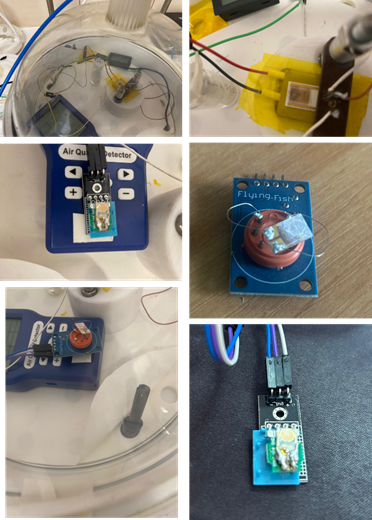
COx
gas detection test installation
During the phase 3 / 2026 a research internship of 30 days were realized by
the senior researcher (1) and PhD students (2) from Technical University of the
Republic of Moldova at INCEMC Timisoara, where the objectives proposed in the
implementation plan were successfully achieved.
Results Dissemination 2026
ISI
papers:
1. C. Bandas, M.-I. Morariu, C. Orha, C.
Lazau, M. Nicolaescu, “Enhanced properties of
electrodes based on Ti/TiO2-Au/rGO composite structures for electrochemical
application“, Crystals 2026,
16(5), 338, https://doi.org/10.3390/cryst16050338
Scientific
communications:
1. T. Braniște, T. Galatonova, M. Nicolaescu, C. Lazau,
C. Bandas, “UV-Assisted CO₂ Sensing
Using Gold Doped TiO₂” EUROINVENT ICIR
2026, International Conference on
Innovative Research Iasi, 28th–29th of May 2026, Iasi,
Romania - poster
2. T. Galatonova, M.
Nicolaescu, T. Braniște, C. Lazau,
C. Bandas, “Influence of Gold Doping on the
Alcohol Sensing Properties of TiO₂”, EUROINVENT
ICIR 2026, International
Conference on Innovative Research Iasi, 28th–29th of May
2026, Iasi, Romania – poster
The
most significant results obtained within this project were
related by publishing scientific
articles indexed in international journals (10 ISI articles), presentations
at international conferences and workshops (16 international conferences),
publishing 1 book chapter relevant to the field of sensors and materials
science.
The innovative nature of the research results was
supported by the development of 2 requested patent applications
submitted to OSIM (A/00255/2025; A/00369/2025) regarding materials
and/or sensor architectures with high application potential. These results create premises for future technology transfer activities and
collaborations with the industrial environment, especially in areas such as
environmental monitoring, pollution control, industrial safety and the
development of intelligent detection systems.
Within the project, research internships were carried
out at INCEMC Timisoara, offering researchers from the Republic of Moldova
the opportunity to work in international research environments and interact
with experts from complementary fields. The knowledge transfer and the
collaboration between INCEMC Timisoara and UTM Chisinau have played an
essential role in strengthening a sustainable cooperation network, capable of
generating new research directions and joint initiatives within future European
programs.